
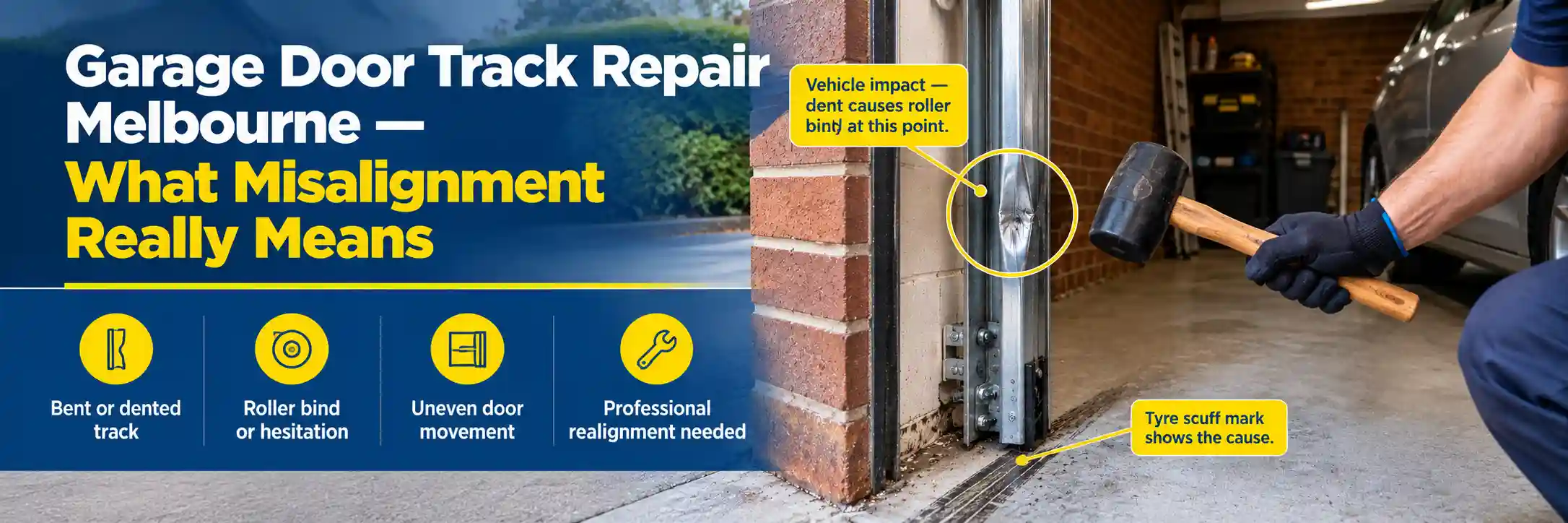
Garage door track repair in Melbourne addresses one of the most physically visible garage door faults — and also one of the most misunderstood. Melbourne homeowners who notice that their garage door is making a grinding or scraping sound during operation, binding at a specific point in its travel, or moving unevenly from side to side often assume the problem is with the door mechanism itself.
In many cases, the fault is in the track system that guides the door — the steel guide rails on each side of the opening that keep the door curtain or sectional panels running in the correct path throughout their travel. Garage door track repair in Melbourne addresses what the track does, what causes it to become misaligned or damaged, how to recognise a track problem before it becomes a door failure, and what the repair involves.
What the garage door track actually does
The track in a garage door system is the structural guide that keeps the door moving in the correct path during every operating cycle. For a roller door, the guide rails on each side of the opening keep the curtain slats running in a straight vertical path as the curtain coils into and out of the drum. For a sectional door, the tracks include both the vertical sections at each side of the opening and the horizontal sections that run along the ceiling, guiding the door panels through the 90-degree turn from vertical to horizontal as the door opens.
The track carries a portion of the door’s operating load — the door’s weight is partially supported by the roller wheels that run in the guide rail during operation, in addition to the spring’s counterbalancing force. A track that is damaged or misaligned changes the load distribution on the roller wheels and the door panels, creating friction, binding, and localised wear at the point of misalignment.
What causes track misalignment in Melbourne garages
Garage door track repair in Melbourne is typically prompted by one of several causes:
- Vehicle impact — the most common cause of sudden track misalignment in Melbourne residential garages. A vehicle that clips the guide rail on entry or exit to the garage bends the rail at the impact point. Even a minor impact that appears to cause minimal damage can bend the steel guide rail enough to cause the roller wheels to bind at the impact point on every subsequent door cycle. In Melbourne’s inner south, where many garages are accessed via narrow driveways adjacent to the house structure, vehicle-to-track contact during parking is a frequent occurrence.
- Fixing bracket loosening over time — the guide rail sections are attached to the garage wall or ceiling by mounting brackets bolted to the structure. Over years of operation and the vibration of thousands of door cycles, the fasteners in these brackets can loosen. A bracket that is no longer firmly fixed to the wall allows the guide rail section it supports to move slightly during door operation, creating a misalignment between the supported section and the adjacent sections.
- Structural movement — Melbourne’s clay soils cause foundation movement in established homes, and in some properties this movement affects the structural elements to which the guide rail brackets are attached. A wall that has moved slightly changes the position of the bracket attached to it, which changes the alignment of the guide rail section the bracket supports.
- Corrosion and deformation — guide rail sections that have been exposed to moisture and the salt air environment near Port Phillip Bay develop corrosion that weakens the steel and can cause the rail profile to deform under operating load. A deformed guide rail creates a track path that is no longer the correct profile for the roller wheels running in it.
Signs of a track problem in a Melbourne garage door
Garage door track repair in Melbourne is most needed when these signs are present:
- Grinding or scraping sound at a specific point in the door’s travel — the roller wheels running through a bent or damaged section of guide rail produce a distinctive sound as they are forced through the incorrect profile. The sound typically occurs at exactly the same point in the door’s travel every time, which identifies the specific location of the misalignment.
- Door slowing or stopping at a specific point — the door decelerates as the roller wheels approach a misaligned section, because the increased friction at the misalignment creates resistance to the door’s travel. For an automated door, the opener’s force setting may compensate for this temporarily — the motor applies more force to push the rollers through the tight section — but this places additional stress on the rollers, the door panels, and the opener motor.
- Door hanging unevenly or off-centre — a track problem on one side of the door causes the door to travel at a different rate on the affected side than on the undamaged side, producing an uneven, visually off-centre door position.
- Visible bending or denting in the guide rail — a direct vehicle impact typically leaves a visible deformation in the guide rail at the impact point. This visible evidence of track damage is the clearest confirmation that track repair is needed.
What Melbourne garage door track repair involves
Garage door track repair in Melbourne depends on the nature and extent of the misalignment:
- Minor misalignment from loosened brackets — the repair involves retightening the mounting fasteners and realigning the guide rail sections to the correct path. For brackets whose fasteners have pulled from the wall surface, larger-diameter fasteners or toggle anchors may be required to re-establish a secure mounting. The alignment is confirmed by operating the door through its full travel and checking for smooth, even movement.
- Bent guide rail section from vehicle impact — for a section of guide rail that has been bent by vehicle impact, the damaged section may be straightened if the bend is minor and the rail steel has not been cracked. Significantly bent sections cannot be straightened to a profile that allows smooth roller wheel travel and must be replaced. A replacement guide rail section is cut to length and installed in the position of the damaged section, with bracket remounting to secure alignment.
- Corroded or deformed guide rail — corroded sections are replaced rather than repaired, as the corrosion weakens the rail steel and the deformation at the corrosion point is typically progressive rather than discrete.
- Full track realignment — for sectional doors where the full track geometry has been disturbed — by structural movement, extensive bracket loosening, or a significant impact — a full realignment involves checking and adjusting the vertical sections, the curved transition sections, and the horizontal sections to the correct geometric relationship with each other and with the door opening. This is the most time-intensive track repair scenario but produces the complete track geometry correction that a partial repair cannot achieve.
Track condition inspection in Melbourne annual maintenance
Garage door track repair in Melbourne is most efficiently managed through annual maintenance that includes a track condition inspection as a standard component. The inspection covers: the guide rail profile for any bending or deformation; the bracket mounting fasteners for tightness; the rail surface for corrosion; and the roller wheel contact with the rail for evidence of uneven wear that indicates a localised rail issue.
Track problems identified during a maintenance visit can typically be addressed within the same visit — a bracket retightened, a minor misalignment corrected, a corrosion-prone section treated — before the problem progresses to the binding and grinding that requires a full repair visit.
Melbourne inner south garages in Windsor, Prahran, South Yarra, and the surrounding City of Stonnington suburbs have a specific track maintenance consideration from the narrower driveway configurations of many inner south properties. A narrow driveway — typical of the terrace and semi-detached homes that make up a significant portion of the inner south’s housing stock — positions the vehicle closer to the guide rails on entry and exit, increasing the probability of minor vehicle-to-rail contact that accumulates as progressive track deformation over time.
A homeowner who notices that their door has been making slightly more noise during operation over recent months and who has a narrow driveway has the specific combination of factors that warrants a track inspection alongside the spring and cable checks at the next maintenance visit. Identifying and correcting progressive minor track deformation before it reaches the binding threshold is significantly less disruptive and less expensive than addressing it once the door has stopped operating smoothly.
Conclusion
Garage door track repair in Melbourne addresses the guide rail system that keeps every door operating in its correct path. Vehicle impact, bracket loosening, structural movement, and corrosion are the four main causes of the misalignment that produces grinding, binding, and uneven door travel. A professional track repair that correctly identifies the cause — not just the symptom — and addresses the full track geometry rather than only the visible damage point produces a lasting repair rather than a temporary correction that allows the underlying cause to manifest as a repeat misalignment.