Garage door cable repair in Melbourne is a service that many homeowners do not think about until a cable fails — at which point the door typically stops working entirely or hangs at a dangerous angle. The cables in a garage door system are the mechanical link between the spring’s stored energy and the door’s movement. They carry significant tension during every operating cycle and operate in the often-dusty, sometimes-wet environment of a Melbourne garage.
Garage door cable repair in Melbourne addresses what the cable actually does in the system, the signs that a cable is approaching failure before it breaks, why a frayed or failed cable is a safety issue rather than simply a performance problem, and what the cable repair or replacement visit involves.
What garage door cables actually do
Most Melbourne homeowners are aware of the spring as the counterbalancing component in their garage door system, but the cable’s role is equally important and the cable’s failure is equally disabling. The cables in a garage door system are steel wire ropes — typically 3 to 4 millimetres in diameter — that connect the spring mechanism to the door and transmit the spring’s force to the lifting action.
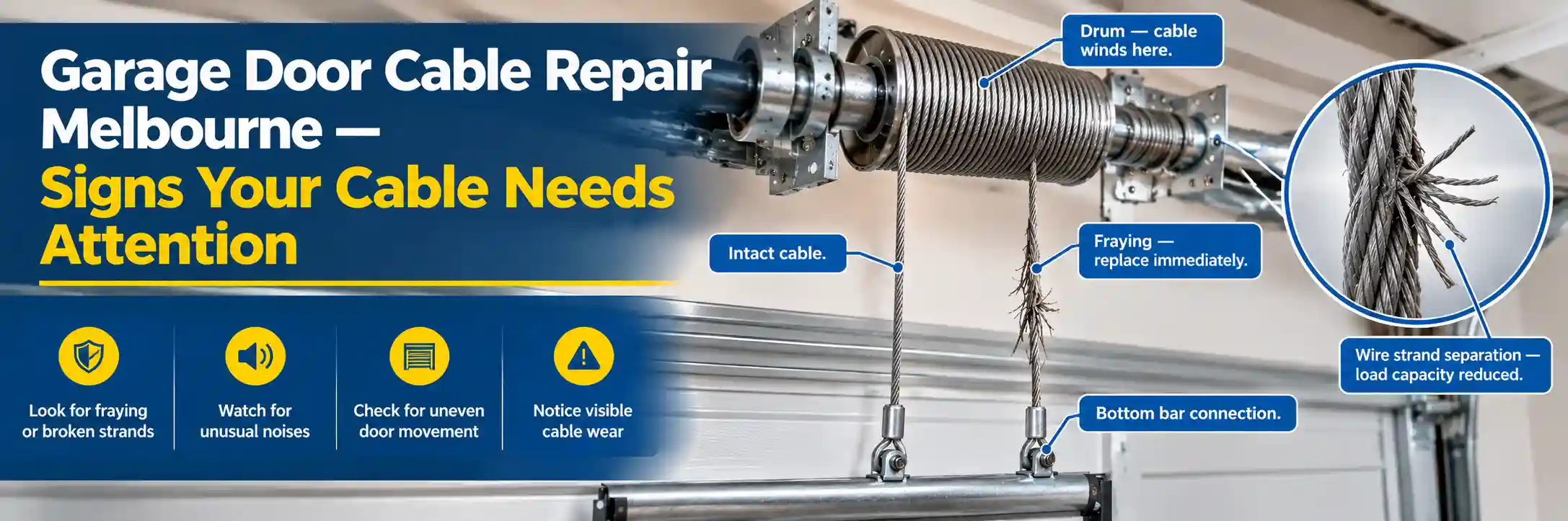
In a roller door, the cables run from the drum at the ends of the spring shaft, down through a pulley or guide at the bottom of each guide rail, and connect to the bottom bar of the door curtain. When the spring winds and the drum rotates as the door closes, the cables wrap around the drum. When the door opens, the cables unwind, lifting the curtain with the spring’s stored energy transmitted through the cable to the door.
In a sectional door, the cables connect the bottom section of the door to the cable drum on the torsion spring shaft. The cable transmits the spring’s lifting force to the bottom of the door, pulling it upward as the spring unwinds. The cable must carry the door’s weight minus what the spring counterbalances — which should be near zero in a correctly tensioned system, but becomes the full door weight if the spring has failed or is losing tension.
The key point is that cables are load-bearing components. They are not simply guides or connectors — they carry the physical force that moves a door weighing 40 to 100 kilograms through its travel cycle. A cable that is compromised is a cable that may fail under load, with the consequences of the door falling or hanging dangerously on the remaining cable.
Signs a Melbourne garage door cable needs attention
Garage door cable repair in Melbourne is most effective when it is addressed before the cable fails, and there are observable warning signs that precede failure:
- Visible fraying — the most direct warning sign. Cable fraying appears as individual wire strands within the cable separating from the twisted bundle. Even minor fraying significantly reduces the cable’s effective load capacity because the intact strands must carry the load that the broken strands are no longer contributing to. A fraying cable should be replaced immediately.
- Rust or corrosion on the cable surface — rust on the cable wire surface indicates that the wire is corroding, which weakens the individual strands and makes them more likely to break under load. In Melbourne’s inner south suburbs near Port Phillip Bay’s salt air, cable corrosion is accelerated compared to inland Melbourne garages.
- Cable off the drum or pulley — a cable that has come off the drum or the bottom pulley is a cable that can no longer transmit force to the door correctly. The door may hang at an angle (if one cable is off and the other is still functional), refuse to open, or move unevenly through its travel.
- Cable slack on one side — a cable that is significantly slacker than the cable on the opposite side of the door indicates that the spring tension is no longer being correctly transmitted through that cable. The door may close unevenly or bind in the guides on the slack side.
- Unusual sounds during operation — a cable that is beginning to fray sometimes produces a scratching or rasping sound as the separating wire strands make contact with the drum or cable guide. This sound is distinct from the more common squeaking of an unlubricated guide rail or roller.
Why a failed cable is a safety issue
Garage door cable repair in Melbourne must be treated with the same stop-use urgency as a spring failure, because a failed cable has the same consequence: the door becomes uncontrolled. A door with one functional cable and one failed cable will typically fall on the side where the cable has failed, rotating around the still-functional cable as a pivot. A door that is falling freely — even a partial fall of one side — is a door that can injure anyone and anything in its path and can cause significant structural damage to the vehicle, the garage structure, or the door itself.
A garage door with a fraying cable should not be operated until the cable has been inspected and either confirmed to be safe for continued temporary use or replaced. If the fraying is significant — more than a few strands broken — the door should be left in whatever position it is currently in and a Melbourne garage door cable repair technician should be called. Operating a door with a significantly frayed cable risks completing the cable failure while the door is in motion.
What a Melbourne cable repair visit involves
Garage door cable repair in Melbourne for a cable that is frayed, corroded, or has failed involves:
- System assessment — the technician assesses the spring condition alongside the cable. A cable that has failed or frayed prematurely may indicate that the spring has lost tension and the cable was carrying more load than it should have been. Replacing the cable without addressing a spring at reduced tension leaves the new cable under the same excessive load that damaged the original.
- Cable removal — the cable is disconnected from the bottom bar of the door and from the cable drum. The cable end fittings are inspected for wear or damage.
- Cable drum inspection — the drum that the cable winds onto is inspected for wear, corrosion, or damage to the winding groove. A damaged winding groove causes the new cable to wind unevenly, accelerating wear at the contact point.
- New cable installation — replacement cables should be specified to the correct diameter, length, and construction for the specific door. For Melbourne’s inner south properties near the bay, stainless steel cables provide corrosion resistance that standard galvanised steel cables cannot match in the salt air environment.
- Cable tension and alignment check — after installation, the cable tension on both sides should be equal, and both cables should track correctly on the drum and through any pulleys or guides without binding or edge contact.
- Full operational test — the door is operated through its full travel cycle manually and with the automatic opener to confirm that both cables are functioning correctly and the door moves evenly.
Preventive cable maintenance for Melbourne garages
Garage door cable repair in Melbourne is largely preventable with an annual maintenance programme that includes cable inspection as a standard component. The inspection covers the full cable length for any fraying, the cable end fittings for wear, the drum winding groove for damage, and the cable surface for corrosion. A cable that shows the early signs of wear — beginning rust, minor fraying at the end fittings — can be replaced at a convenient scheduled time rather than as an emergency when it fails.
Cable lubrication during the maintenance visit extends cable life by reducing the friction between the cable and any guides or pulleys it passes through. A dry cable that runs over a cable guide progressively wears at the contact point; a lightly lubricated cable distributes the contact stress more evenly across the cable strands. For Windsor and inner south Melbourne garages, where the cable may be in a salt air-affected environment, a corrosion-inhibiting lubricant provides protection against the corrosion mechanism that salt air promotes.
Conclusion
Garage door cable repair in Melbourne addresses the component that translates the spring’s stored energy into door movement and that must carry the door’s weight reliably through every operating cycle. Visible fraying, surface corrosion, cable slack, or a cable off its drum are signs that require immediate attention — not monitoring through a few more weeks of operation. A cable replacement that includes drum inspection, correct cable specification for the Melbourne environment, and spring condition assessment alongside the cable work is the thorough approach that prevents the cable failure from being a repeat event at an accelerated interval.