
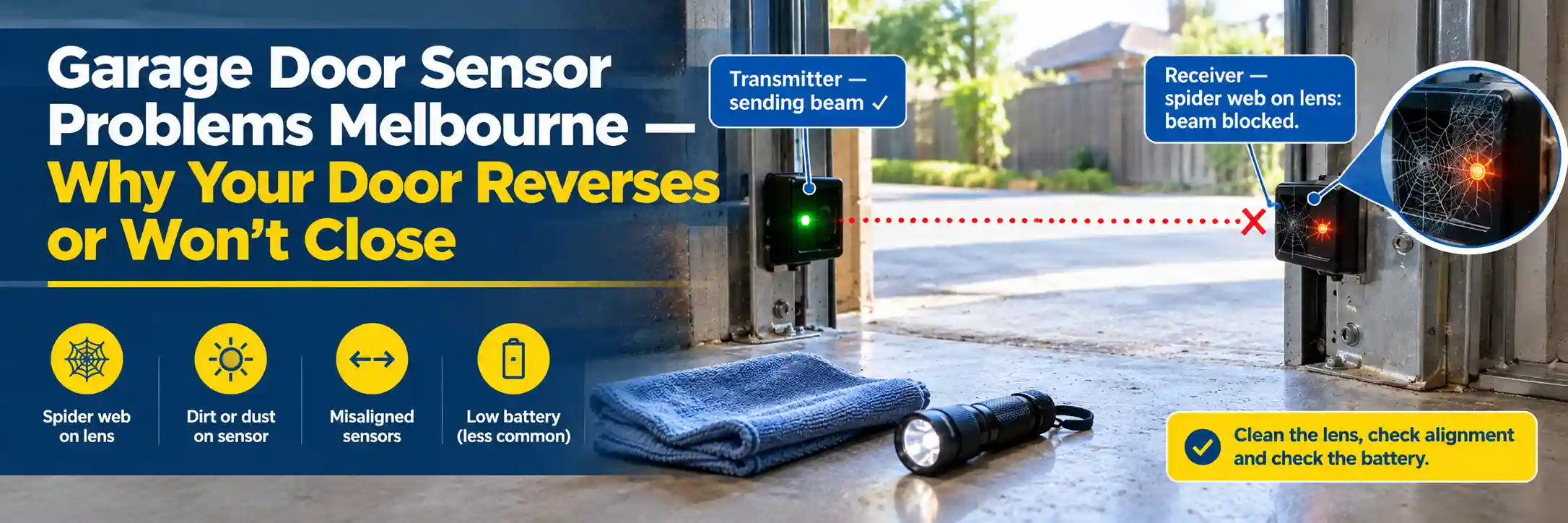
Garage door sensor problems in Melbourne are responsible for a significant proportion of the “my door won’t close” calls that Melbourne garage door service companies receive, and they are also responsible for a significant proportion of unnecessary call-out fees when the fault turns out to be something the homeowner could have addressed with a ten-minute check.
Understanding what garage door sensors do, why they fault, how to distinguish a sensor problem from a mechanical or motor fault, and what the sensor repair or realignment involves is knowledge that saves Melbourne homeowners both time and the cost of a call-out for a fault that a simple adjustment resolves.
What garage door safety sensors actually do
Garage door safety sensors — also known as photoelectric sensors, safety eyes, or reversing sensors — are a safety requirement for all automated garage doors sold and installed in Australia under the current safety standard. They are designed to prevent the garage door from closing on a person, animal, or vehicle that is in the path of the closing door.
The sensor system consists of two units mounted at the base of the guide rails on each side of the garage opening, facing each other.
The transmitter unit on one side emits a continuous infrared beam. The receiver unit on the other side detects this beam. While the beam is detected — meaning the path between the two sensors is clear — the door is permitted to close. If the beam is interrupted — meaning something is in the path — the door is commanded to reverse immediately if it is closing, or to remain in the open position if it has not yet started to close.
This is a life-safety system, and it functions correctly in the vast majority of Australian garage door installations. The problems arise when the sensors generate a fault signal — indicating an interrupted beam — when the path between them is actually clear. This false fault condition is what produces the symptoms that Melbourne homeowners experience as “the door won’t close” or “the door keeps reversing for no reason.”
The most common causes of sensor problems in Melbourne
Garage door sensor problems in Melbourne have several distinct causes, each producing the same observable symptom but requiring different corrective actions:
- Sensor misalignment — the transmitter and receiver units must face each other precisely for the infrared beam to pass correctly from one to the other. A sensor unit that has been nudged out of alignment — by a vehicle brushing past it during parking, by settling of the bracket mounting surface, or by deliberate repositioning — produces a fault condition because the beam misses the receiver. The indicator lights on the sensor units show whether both units are receiving correctly: a solid light on both units indicates alignment; a blinking or absent light on the receiver indicates the beam is not being received.
- Debris or dirt on the sensor lens — the infrared beam passes through a small lens on each sensor unit. Dust, spider webs, insects, moisture, or any other material on the lens face partially blocks the beam and can reduce the signal strength to the point where the receiver no longer detects it reliably. In Melbourne’s variable weather, condensation inside or on the sensor lens is a specific seasonal cause of intermittent sensor faults that appear in winter and resolve in summer.
- Direct sunlight interference — the infrared receiver cannot distinguish between the infrared beam from the transmitter and bright direct sunlight containing infrared wavelengths. A receiver unit that is positioned where direct sunlight hits it at certain times of day — typically early morning or late afternoon in Melbourne’s summer — will register a false full-signal condition that prevents the fault detection from working correctly, or in some sensor designs will be overwhelmed by the sunlight signal and register a fault. This cause of sensor problems is seasonal and time-of-day specific.
- Wiring fault — the sensor units are connected to the opener motor’s control circuit by low-voltage wiring. A wiring fault — a broken wire, a corroded connection, or a connection that has loosened from its terminal — produces a permanent fault signal that the door interprets as a beam interruption. A wiring fault is less common than misalignment or lens contamination but produces a symptom that does not resolve with sensor cleaning or adjustment.
- Failed sensor unit — sensor units have a finite service life and can fail electronically. A sensor unit whose infrared emitter or receiver circuit has failed produces a permanent fault condition. Failed units must be replaced rather than adjusted or cleaned.
How to diagnose the sensor problem before calling a Melbourne technician
Garage door sensor problems in Melbourne have a diagnostic sequence that Melbourne homeowners can complete before calling a technician:
- Check the sensor indicator lights — both sensor units have indicator lights. A solid green light on both units typically indicates that the beam is being received correctly. A blinking, orange, or absent light on the receiver unit indicates a fault. Note which unit is showing the fault indicator.
- Clear any obvious obstructions — walk the path between the two sensor units and confirm there is nothing physically in the beam path. Remove any garden tools, bikes, or other items that may have been placed near the door since it last worked correctly.
- Clean the sensor lens faces — use a soft, dry cloth to wipe both sensor lens faces. Even a light dust film can affect beam reception. After cleaning, check whether the indicator lights have returned to their normal state.
- Check sensor alignment — look at both sensor units from the side. They should be pointing directly at each other, at the same height above the floor. If one unit is visibly pointing off to the side or upward, it has been knocked out of alignment. Loosen the mounting bracket and carefully realign the unit until the receiver unit’s indicator light shows the correct beam-received state.
- Check for sunlight interference — if the sensor fault occurs only at certain times of day, direct sunlight may be the cause. Observe whether the fault coincides with direct sunlight on the receiver unit and whether it resolves when the sun moves.
- If none of the above resolves it — call a Melbourne garage door sensor technician. Wiring faults and failed sensor units require professional diagnosis and replacement.
What a Melbourne sensor repair visit involves
Garage door sensor problems in Melbourne that require a professional visit involve the technician completing the same diagnostic sequence above with the addition of electrical testing. A multimeter check on the sensor wiring confirms whether the wiring circuit is intact or whether a break or fault exists in the circuit between the sensor units and the motor control board.
If the wiring is intact and the sensor units themselves are showing correct indicator behaviour after a professional alignment, the fault may be in the motor’s control circuit — the component on the opener’s circuit board that interprets the sensor signal. Control board replacement is the last-resort diagnostic step for a persistent sensor fault that does not resolve with sensor cleaning, alignment, or wiring repair.
Sensor unit replacement in Melbourne is a straightforward same-visit repair for most major Australian opener brands. The sensor units are typically universal between models within a brand’s current range and are stocked by distributors across Melbourne for same-day supply. A Melbourne technician attending for a sensor fault will typically carry replacement sensor units for the major brands in their service vehicle.
Sensor maintenance — keeping Melbourne garage door sensors working
Garage door sensor problems in Melbourne are reduced by including sensor inspection in the annual maintenance visit. The maintenance inspection covers: cleaning both sensor lens faces; confirming that both indicator lights are showing correct beam-received status; checking the mounting bracket security; and verifying that the wiring connections at both sensor units are secure. This five-minute addition to the annual maintenance visit is the prevention for the majority of sensor faults that develop gradually from lens contamination, bracket loosening, or wiring connection deterioration.
Melbourne’s inner south suburbs — Windsor, Prahran, South Yarra, and St Kilda — have a specific sensor maintenance consideration from the urban environment. Spider webs are a particular problem for sensor lenses in Melbourne’s inner suburbs, where the warm, sheltered environment of a garage interior creates ideal conditions for spider nesting around the sensor units.
A spider web across a sensor lens can interrupt the infrared beam completely, and the web may be too fine to be obvious without looking directly at the lens face with a torch. If a Melbourne garage door sensor problem has appeared suddenly without any other change to the door or its environment, checking the sensor lens faces for spider webs with a torch is the first diagnostic step that resolves more Melbourne sensor calls than any other single action.
Conclusion
Garage door sensor problems in Melbourne produce the symptom of a door that will not close or that reverses without apparent reason, and they have a range of causes from simple lens contamination to failed electronics. The diagnostic sequence — indicator lights, obstruction check, lens clean, alignment check, sunlight test — resolves the majority of Melbourne sensor problems without a professional visit. For faults that persist after this sequence, a Melbourne garage door sensor technician’s electrical testing of the wiring circuit and sensor units provides the definitive diagnosis and the same-visit repair for most sensor system failures.