
Garage door spring replacement in Melbourne is the most requested emergency repair in the garage door service industry, and also one of the most misunderstood. Melbourne homeowners who have experienced a spring failure — the loud crack, the door that will not open, the heavy curtain that will not lift — know that something has gone wrong and that a technician is needed.
What they often do not know is what the technician is going to do when they arrive, what the replacement actually involves, how long it takes, and what distinguishes a spring replacement done correctly from one done quickly. This guide covers the full process of garage door spring replacement in Melbourne — from arrival to departure — so that Melbourne homeowners know exactly what a professional spring replacement visit should include.
What the spring does and why it matters to get the replacement right
The spring in a Melbourne garage door system is not simply a component that helps the door open. It is the counterbalancing mechanism that makes the door operable at all. A correctly tensioned spring makes a door that weighs 40 to 100 kilograms effectively weightless to operate — manually light to lift and not a significant load on the automatic opener motor.
An incorrectly tensioned spring — one wound to more or less tension than the door’s weight requires — leaves the door either fighting against an over-tensioned spring or straining against the full door weight with an under-tensioned one. The correct tension is not a default setting that applies to every spring of a given size: it is specific to the weight of the specific door the spring is installed on, and it must be calibrated during the replacement rather than assumed.
What a Melbourne spring replacement technician does on arrival
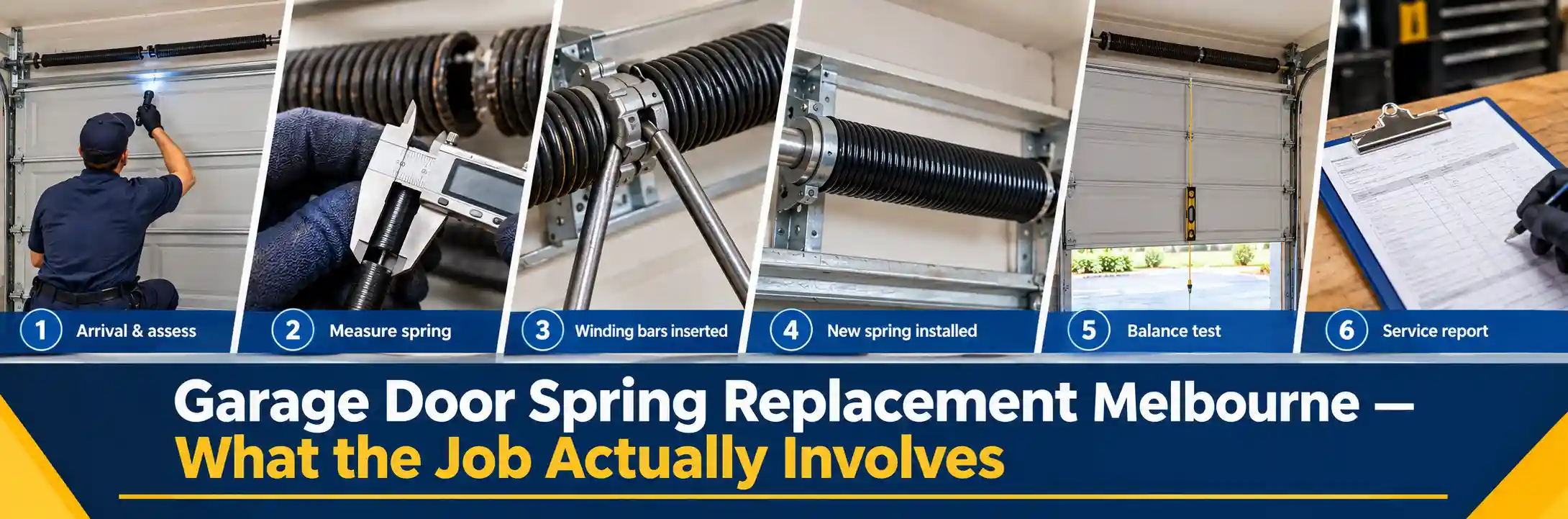
Garage door spring replacement in Melbourne begins with a system assessment, not with the spring itself. A thorough technician arriving at a Melbourne property for a spring replacement will:
- Visually confirm the spring failure — identify whether the failed spring has snapped (gap in the coil) or lost tension (no visible gap but door is heavy), and whether the door is stuck open or closed.
- Assess the full door system — not just the spring. The cables, cable drums, rollers, guide rails, and the automatic opener (if fitted) are all components that a spring failure can affect. A cable that was near the end of its service life may have been operating under extra stress without the spring correctly counterbalancing the door — this accelerated wear may have progressed significantly.
- Measure the existing spring specification — the wire diameter, coil diameter, length, and wind direction of the failed spring must be measured rather than assumed. A spring that appears standard may be a non-standard size from a previous non-specialist installation. Matching the specification precisely, or correctly recalculating the specification for the door’s weight, is the technical foundation of a replacement that works correctly.
- Confirm the door’s weight — for a door whose spring specification is not clearly matched to the door type, or for any large or non-standard door, confirming the door’s actual weight or calculating it from the door’s dimensions and material ensures the replacement spring is not under-specified for the application.
The spring removal and replacement sequence
Garage door spring replacement in Melbourne for a torsion spring system — the most common type on Melbourne roller and sectional doors — follows a specific sequence that safety requires. A torsion spring wound to counterbalance a 60-kilogram door stores significant mechanical energy. The removal sequence:
- The technician inserts the correct winding bars into the winding cone on the spring shaft — specific tools that engage the cone at the correct position. Improvised tools, general bar stock, or screwdrivers used in place of winding bars are the specific cause of the most common spring replacement injuries and are never appropriate.
- The spring tension is released incrementally — never all at once — through a sequence of controlled quarter-turns with the winding bars. Each quarter-turn releases a defined amount of stored energy. The technician’s positioning during this sequence keeps them clear of the plane in which the winding cone would release if the bar slipped.
- Once the tension is fully released, the winding cone set screws are loosened, the spring end is disconnected from the spring anchor bracket, and the spring is slid off the shaft and removed.
- The replacement spring is installed by reversing the removal sequence — slid onto the shaft, connected at the anchor, wound to the correct tension through the same incremental quarter-turn sequence, and the set screws tightened at the correct tension.
The balance test — confirming the replacement is correct
Garage door spring replacement in Melbourne is not complete until the door has been balanced and tested. The balance test is the specific quality check that confirms the replacement spring has been wound to the correct tension for the door’s weight:
The automatic opener is disconnected by pulling the emergency release cord. The door is manually lifted to the midpoint of its travel — roughly halfway between fully closed and fully open — and released. A correctly tensioned spring holds the door stationary at the midpoint with no tendency to rise or fall. A door that slowly descends has a spring that is under-tensioned for the door’s weight. A door that rises upward is over-tensioned.
A midpoint balance that is not correct requires adjustment: additional winding for an under-tensioned spring, release of tension for an over-tensioned one. The balance test is repeated after each adjustment until the door holds correctly at the midpoint. A spring replacement that is not balance-tested before the technician leaves is a replacement that may be leaving the door with an incorrect tension that will shorten the replacement spring’s service life and create unpredictable operation.
Two springs or one? The Melbourne replacement decision
Garage door spring replacement in Melbourne for doors with two springs — which includes many sectional doors and some roller door configurations — presents the question of whether both springs should be replaced or only the one that has failed. The recommendation is consistent across the professional Melbourne garage door service industry: replace both springs simultaneously.
The reason is straightforward. The second spring has been in service for the same number of operating cycles as the failed spring and has been in the same Melbourne environment for the same period. It has accumulated the same fatigue and, in bayside Melbourne, the same salt air corrosion.
The probability that the second spring will fail within a relatively short period after the first is high — high enough that the call-out fee for a second spring replacement visit within one to two years is a foreseeable cost that the simultaneous replacement avoids. Both springs replaced simultaneously with corrosion-resistant, high-cycle spring specifications is the replacement outcome that provides the longest interval before the next replacement visit.
Spring specification upgrades for Melbourne conditions
Garage door spring replacement in Melbourne provides the opportunity to specify replacement springs that are better suited to Melbourne’s conditions than the springs they replace. Standard residential springs are rated at 10,000 cycles — approximately 13 years at two operations per day. High-cycle alternatives rated at 20,000 or 30,000 cycles are available and represent a longer service life for Melbourne households where the garage door cycles frequently.
For Melbourne’s inner south suburbs near Port Phillip Bay — Windsor’s proximity to St Kilda and the bay foreshore means that properties within a few streets of the bay receive meaningful salt air exposure — galvanised or powder-coated springs provide corrosion resistance that bare steel springs do not. A spring replacement in Windsor and the surrounding inner south Melbourne suburbs that specifies a coated spring in a high-cycle rating is the combination that provides the longest reliable service life for the specific Melbourne environment.
After the replacement — what to expect
Garage door spring replacement in Melbourne completed by a professional technician produces a door that operates smoothly, feels light to manually operate, and runs the automatic opener without strain. The technician should lubricate all moving components — not just the new spring — before leaving, and should provide a brief demonstration of the door’s balanced operation. A service report documenting the spring specification replaced, the tension calibration completed, and any other observations about the door’s condition provides the homeowner with a record for future reference and warranty documentation.
Conclusion
Garage door spring replacement in Melbourne done correctly is a systematic process: system assessment on arrival, spring measurement before ordering, controlled winding bar removal and installation, balance test before departure, and simultaneous replacement of both springs in a two-spring system.
The difference between a replacement done correctly and one done quickly is the balance test, the system condition assessment, and the component inspection that a thorough technician performs on every visit regardless of how straightforward the presenting fault appears. Melbourne homeowners who know what the process should include are in a better position to recognise when a spring replacement visit is being completed to the standard they are entitled to expect.